Cruzr's technical framework
Introduction
As a developer, when you try to write your first program on Cruzr, you may have many questions such as “What is the structure of the Cruzr system?”, “How do you create a simple project?”, "What is the difference between a Cruzr robot and other android devices such as mobile phones, tablets, and TV boxes?", and "How do the modules of the robot work?", and so on.
The following is a brief introduction to the Cruzr's technical framework, which will not only answer the questions above, but also let you understand the internal implementation principles of Cruzr, so everyone can quickly access their own programs.
Cruzr framework
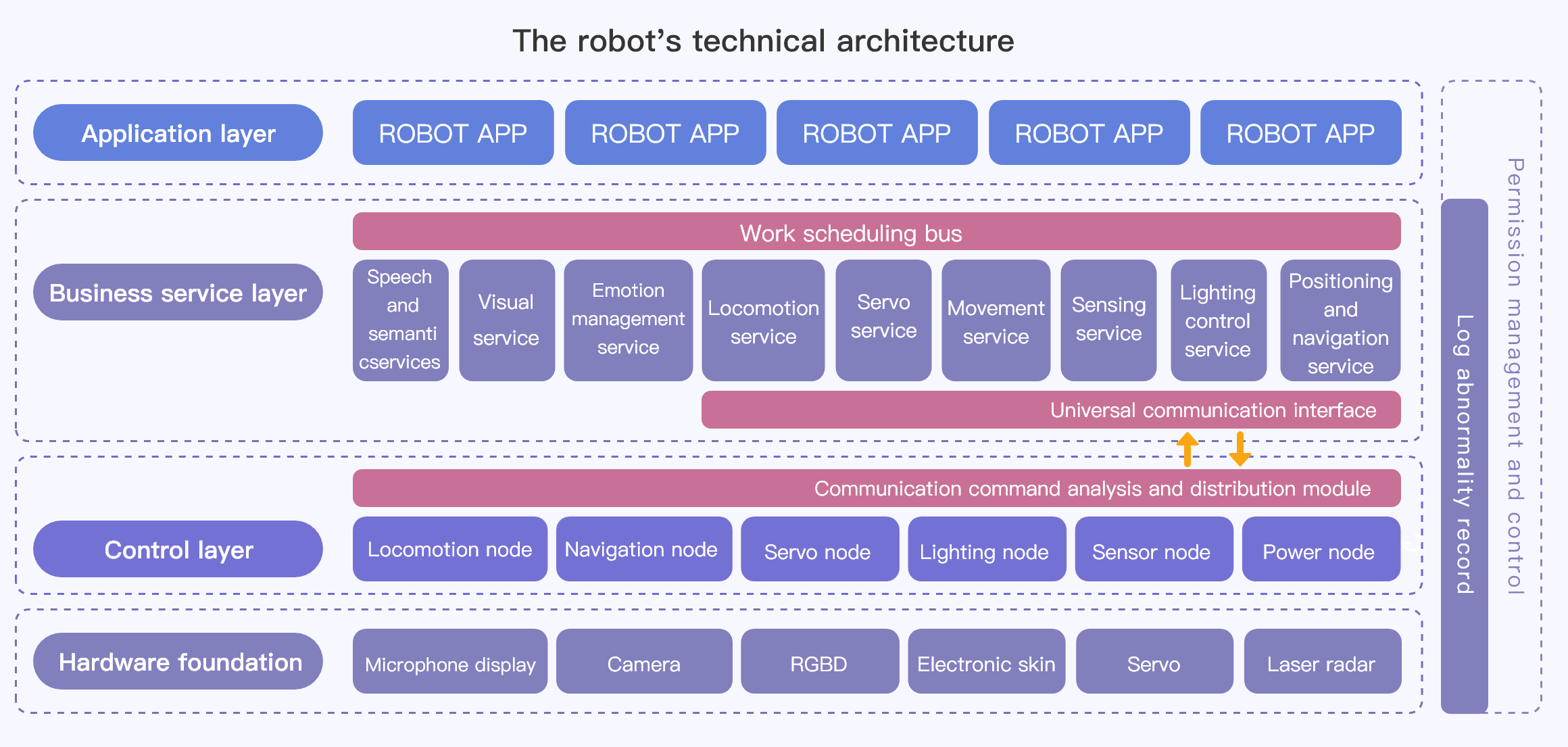
Cruzr's internal implementation principle
By analyzing the Cruzr's framework, we can see that Cruzr's software structure is the application layer, service layer, and control layer from top to bottom. The application layer receives the events entered by the user and then calls the functions provided by the service layer through the API interface. The service layer sends the corresponding instruction to the control layer through the socket. The control layer controls the corresponding hardware module according to the instructions. At the same time, the data generated by the sensor is uploaded to the service layer through the control layer, and then returned to the application layer through the API interface. The application layer then sends the feedback to the user through interface display or voice.
What are the differences?
The difference between Cruzr and other android devices is that it has a more powerful hardware foundation and requires more service layers to manage it. However, developers only need to pay attention to our business service layer and the provided API interface. Therefore, customization and development based on Cruzr are the same as other android platforms.